How it works
People hold back from tip lines because they fear their name could leak, and police waste time on tips that go nowhere. For our final year project we designed a tip system where privacy comes from cryptography, not from a promise.
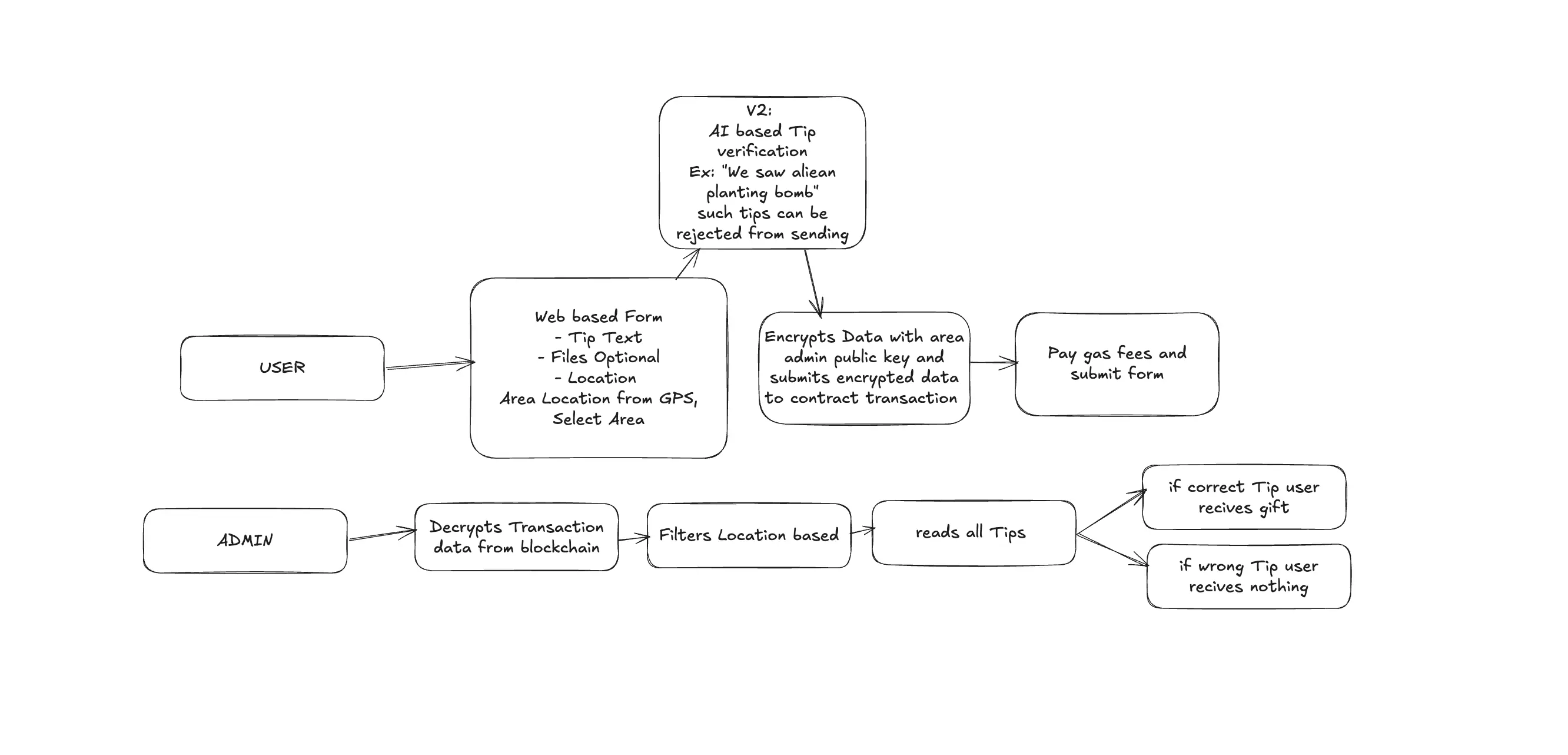
The design: a tipster writes the tip, adds a location and optional photos or videos. The browser encrypts it with the public key of the police admin for that area, then sends it as a transaction to a smart contract, where it cannot be edited or deleted. Only that admin's private key can decrypt it.
Data on a blockchain is public, so the encryption is what keeps a tip private, not the contract. The contract handles the rest: only the police account can read tips, and each tip moves from submitted to accepted to rewarded, so a useful tip can earn a reward.
The design also covers what code alone can't: the form asks for no personal details, and tipsters are pointed to privacy-focused wallets and to Tor or a VPN.
Next on the plan was an AI check before submitting, to stop tips like "we saw aliens planting a bomb" before they reach the police.
What it does
- Solidity contract that stores the encrypted location, file hash and tip text.
- Owner-only reads, and accept and reward steps with an event for each.
- Pages to submit a tip, a police dashboard, an FAQ and an about page.
- MetaMask sign-in on the Sepolia testnet.
Stack
Solidity / Hardhat / OpenZeppelin / Next.js / React / TypeScript / wagmi / viem / MetaMask / Sepolia